1881 - 1977
By: Annalisa Zwirba | Date Added:
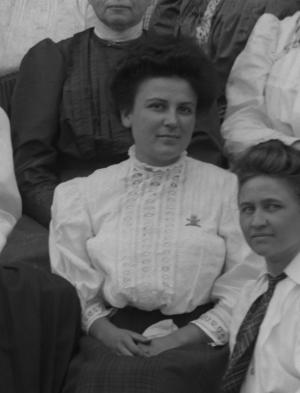
Maria de Lopez rallied the crowd gathered at Los Angeles Plaza on October 3, 1911 by giving a speech in favor of woman’s suffrage entirely in Spanish, an unprecedented event for the time. An educator, translator, and clubwoman, Lopez helped win the vote for Californian women with her oratory and the writings she translated into Spanish. In addition to her suffrage work, Lopez fought for decades to preserve Spanish- and Mexican-American cultural heritage. Maria Guadalupe Evangelina de Lopez was born in Los Angeles in 1881, at Casa Vieja, her family’s home at the San Gabriel Mission. She lived there with her parents, Juan and Guadalupe, and several siblings. Throughout her life she also went by Lupe, Eva or Marie. Her father, a blacksmith, was born in Mexico and was descended from the prominent Lopez family. Lopez graduated from Pasadena High School in 1897 and then studied at the Los Angeles State Normal School (which would later become UCLA) to be a teacher. She started her career teaching English as a second language at Los Angeles High School and soon began working as a translator. In 1902, she was the youngest instructor on staff at the University of California. Lopez returned to San Gabriel to live with her mother and siblings following the death of her father in 1904. In the 1910s, Lopez and her sister Ernestina ran their own Spanish-language school out of their home as a side business, in addition to frequent translation work. Eventually Lopez taught at UCLA, possibly the first Latina ever to do so. Lopez was active in her local Votes for Women Club and became president of the College Equal Suffrage League in 1911. She played an important role in the campaign to enfranchise California’s women by translating suffrage materials into Spanish in order to reach Hispanic women. At a 1911 Votes for Women Club rally in Los Angeles Plaza, Lopez took the stage and spoke in support of woman suffrage in Spanish, reportedly the first in the state to do so. She then traveled the region, distributing suffrage posters and literature and giving speeches, all in Spanish. Lopez authored a forceful opinion piece in the Los Angeles Herald on August 20, 1911, arguing that California could not call itself a democracy while disenfranchising half its citizens. On October 10, 1911, the suffrage proposition passed and California became the sixth state in the nation to approve suffrage for women, nine years before the passage of the 19th Amendment. Lopez was among the women considered by leading suffragists in Los Angeles to serve as a representative from California to the 1913 Woman Suffrage Parade in Washington, D.C. In 1914, Lopez returned to political advocacy, translating materials in support of labor-related initiatives on that year’s ballot into Spanish. After World War I broke out, Lopez left her teaching job to aid the war effort. She first went to New York City, where she took courses in auto mechanics and flying. She then went to France to work as an ambulance driver. In 1918, the French government cited Lopez and three other American women for bravery after the chateau-turned-hospital where they were stationed was bombarded by enemy fire and the four worked all night carrying wounded soldiers to safety. Lopez married Hugh Lowther, a fellow educator who worked as a professor at Occidental College. After her marriage she was often referred to as Maria de Lopez Lowther or Maria de Lopez de Lowther. In addition to her suffrage work, Lopez was an avid clubwoman in the Los Angeles area. She helped to found the Woman’s City Club of Los Angeles, and belonged to the Woman’s College Club, the Woman’s Business Club, and the Executive Board of the High School Teachers’ Association of Los Angeles. In the 1920s and 1930s, Lopez served as the Spanish instructor for the Spanish section of the Ebell Club, a cultural and philanthropic women’s organization in Los Angeles. A devoted teacher, Lopez worked hard to educate the public about California culture and to promote Spanish-language instruction, popular causes among Spanish-descended clubwomen of the era. From the 1920s to the 1940s, Lopez was a sought-after guest speaker for a wide range of organizations, often hosting them in her family home in the San Gabriel Mission, now known as the Lopez-Lowther Adobe. Lopez also served as the 17th president of the UCLA Faculty Women’s Club from 1937 to 1938. Lopez died on November 20, 1977 in Orange, California. She is buried at San Gabriel Christian Church in Los Angeles.
click hereShare This Story


Share your thoughts on this story with us. Your comments will not be made public.
Email
Copyright ©2016 - Design By Bureau Blank