1961 - Today
By: Fanta Kaba | Date Added:
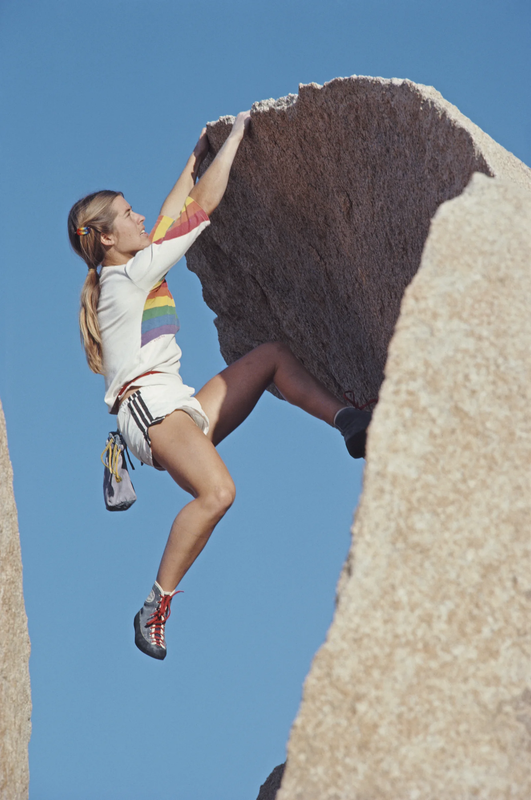
Carolynn Marie "Lynn" Hill (born January 3, 1961)[2] is an American rock climber. Widely regarded as one of the leading competitive sport climbers in the world during the late 1980s and early 1990s, she is famous for making the first free ascent of the difficult sheer rock face of The Nose on El Capitan in Yosemite Valley, and for repeating it the next year in less than 24 hours. She has been described as both one of the best female climbers in the world and one of the best climbers of all time.[3][4][5] One of the first successful women in the sport, Hill shaped rock climbing for women and became a public spokesperson, helping it gain wider popularity and arguing for sex equality. Hill has publicized climbing by appearing on television shows and documentaries and writing an autobiography, Climbing Free: My Life in the Vertical World. Hill was a gymnast early in life, nearly broke a world record lifting weights, and ran competitively. She took to climbing at a young age, showing a natural aptitude for the activity, and became a part of the climbing community in Southern California and Camp 4 in Yosemite Valley. She traveled around the United States during the early 1980s climbing increasingly difficult routes and setting records for first female ascents and for first ascents. From 1986 to 1992 Hill was one of the world's most accomplished sport climbers, winning over thirty international titles, including five victories at the Arco Rock Master. This coincided with the era when the leading female climbers caught up with the leading men. In 1992, Hill left competitive climbing and returned to her first love: traditional climbing. She set for herself the challenge of free climbing The Nose of El Capitan, her greatest climbing feat. Hill continues to climb and has not stopped taking on ambitious climbs. As of 2013, she was a sponsored athlete for the Patagonia gear and clothing company and owned a small business that offered climbing courses. Hill started to participate in climbing competitions in the mid-1980s, but one of her first significant accomplishments was in 1979. She became the first person to free climb Ophir Broke in Ophir, Colorado, which has a difficulty rating of 5.12d and was the hardest route ever climbed by a woman at that time.[6] It was the hardest crack climb in Colorado at the time and there were only one or two harder ones in Yosemite.[28] Long was amazed by her feat. He has said "that's when I knew for certain that this woman had extraordinary talent".[28] The regional guidebook credits Long with the first free ascent of the route; Hill speculates the reason for this is that at the time she was an unknown climber and known only as Long's partner and protege.[38] In her autobiography, Hill explains that it was during this climb that she realized it is not a person's size or strength but ability to be creative on the rock that is important: "The big lesson for me ... was to realize that despite what appeared to be a limitation due to my small stature, I could create my own method of getting past a difficult section of rock. John's size and power enabled him to make long reaches and explosive lunge moves that were completely out of my range. I, on the other hand, often found small intermediate holds that John couldn't even imagine gripping ... Short or tall, man or woman, the rock is an objective medium that is equally open for interpretation by all."[38] Living near the Shawangunks during her college years, Hill pioneered many new free climbing routes.[14] In 1984 at The Gunks she performed an on-sight first ascent of Yellow Crack (5.12c) and Vandals (5.13a); Vandals was the most difficult route on the East Coast at the time and the area's first climb of its grade.[6][39] Her lead of Yellow Crack was a very dangerous ascent, her climbing partner at the time Russ Ruffa calling it "one of the boldest leads I've ever seen ... I had tried leading it. I knew you had to totally commit to doing the moves, otherwise the chance of surviving would be minimal. Those are the moments that really stand out—when you see someone totally on the edge."[34] It was her climb of Vandals that led Hill to reconsider her climbing style; rather than begin the climb again every time she fell or leaned on the rope for support, she hung on the rope in her harness to gain more information about the climb. As she writes in her autobiography, "In one moment I had, to some degree, thrown out years of climbing philosophy ... The subtle advantage of hanging on the rope to figure out the crux moves gave me the added information that helped me learn and eventually succeed on the route. The old style of climbing suddenly seemed rigid, limited, and contrived."[40] That year, she performed a series of impressive feats, leading Tourist Treat on-sight with only one fall, "perhaps the most difficult first ascent in the north country at the time".[41] She was arguably "the best climber in the Gunks", as local climbing legend Kevin Bein called her, and "no man was climbing significantly better" than her.[41] As a result of Hill's impressive climbs in The Gunks, she was invited to climb in Europe in 1986. The French Alpine Club invited a group of elite American climbers to climb in the Verdon Gorge, Fontainebleau, and Buoux.[13] Hill felt an immediate affinity for French culture and climbing. She particularly enjoyed climbing on the limestone common in France because it has many pockets and edges, producing "wildly acrobatic climbs" with low risk. Moreover, these types of climbs are ideal for people of small stature, like Hill.[42][43] She tried sport climbing in France for the first time that year. Inspired and intrigued by European climbing culture, she returned later and took part in Arco e Bardonecchia Sportroccia '86, the second edition of the first international sport climbing competition, which later became the Rock Master annual event. The event was divided into two stages, one in Arco and one in Bardonecchia, Italy. She competed against other women on extremely difficult routes, gaining points for style and speed.[13] She lost to Catherine Destivelle in a "disputed ruling" but won in the following year.[6] Destivelle in her autobiography, reckons she won that year because she planned to climb fast from the beginning, as speed was decisive in case of equality, which she doubts Hill was aware of when starting the competition.[44] In an interview, Hill has said that this first competition was "disorienting" because she did not understand the language, the "format" or the "judging" nor did the organizers of the competition. "There were a lot of politics involved, a lot of nationalism and disorganization. The rules seemed to change during the event. I remember asking about the disparity between prize money for men and women. The only response I got was, 'If the women climb without their tops, then we'll pay them the same.'" However, she continued with competition climbing because she found it stimulating to climb with "other strong women".[43] In one interview, Hill said that "if there wasn't a Catherine Destivelle or Luisa Iovane ... or whoever there, then it would be anticlimactic."[4] Destivelle became Hill's main competition in the late 1980s while Isabelle Patissier emerged to challenge her in the early 1990s.[45] She became a professional climber in 1988 and the subsequent interviews, photoshoots and media appearances led to her becoming a spokesperson for climbing.[14] As Hill explained, competition climbing is "such a different activity than going out and climbing on rock ... You're in front of all these people ... You're there to perform." [34] From the beginning of her sport climbing career, Hill was aware that the sport was evolving and growing. For example, she pointed out in an interview that some competition organizers would chop down trees and alter rocks just for the sake of a competition; she could foresee that competitions would all eventually take place on artificial walls for environmental reasons.[13] Throughout the early 1980s, Hill had remained a traditionalist, but after her 1986 trip to Europe, she started adopting many sport climbing techniques.[39] For instance, she had resisted hang-dogging (hanging on the rope at any point d uring the climb), holding with the philosophy that it was cheating, but after experimenting with it during her ascent of Vandals, she found it a useful way to learn challenging climbs.[14][46] During the mid-1980s, there was great tension in the climbing community between traditionalists and new sport climbers. There was even a "Great Debate" in 1986 at the American Alpine Club at which a panel of all-star participants—including Hill—were invited to discuss the merits of the two different styles, especially sport climbing that required the insertion of fixed bolts into the rock.[47][48] Hill has argued that "the purpose of climbing is to adapt yourself to the rock. You work on yourself to overcome the obstacle of the rock ... I believe climbers should leave the rock as unaltered as possible ... you have a responsibility not only to put in safe bolts but to put them in logical places—to do the least possible alteration of the rock to establish the best possible experience for others".[13] Hill met fellow Gunks climber Russ Raffa on her first trip to New York and by 1984 he had become "her constant companion".[95] On October 22, 1988, the two married; however, their relationship ended in March 1991 in part because Hill wanted children and because the couple rarely saw each other.[45][96] At the same time, Hill moved to Grambois, France, to pursue her climbing career; she settled there because of the world-class climbing areas in the Lubéron region and the many friends she had there.[45][97] While living and climbing in Europe, Hill became fluent in both French and Italian.[82] Hill met her partner as of 2004, chef Brad Lynch, on a climbing trip in Moab, Utah,[3] and at the age of 42, she gave birth to a son. Hill has spoken frequently about how having a child lessened the amount of time she had for climbing but not her love for it. As she said in one interview, "I feel that right now, it doesn't have to be all about me and my experiences. I was ready to begin a new role; to face new challenges and adventures as a mother. It's a good learning experience adjusting to the sacrifices that need to be made."[98] In 2015 she was inducted into the Boulder (Colorado) Sports Hall of Fame.[99]
click hereShare This Story


Share your thoughts on this story with us. Your comments will not be made public.
Email
Copyright ©2016 - Design By Bureau Blank