
1895 - 1976
By: Manet Davis | Date Added:
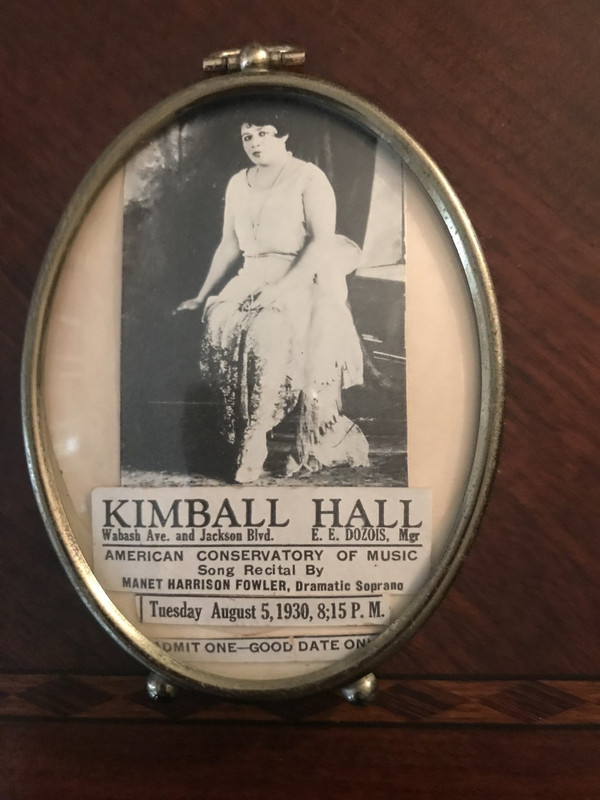
Manet Harrison Fowler was an African American musician, opera singer, artist, voice coach, piano teacher, music educator, wife, mother and midwife. She was a child prodigy, learning to play the piano her grandfather gave her at age 4 and performing piano recitals at churches and concert halls at age 6. She was born August 30, 1895 in Fort Worth, Texas to Louisiana natives Taylor Henry Harrison, an African American and graduate of the Homer Baptist seminary; and Carrie (Vickers) Harrison, a creole beauty of African, French and Irish descent and a member of the Order of the Eastern Star. Manet was the oldest of eight children, three sisters and four brothers. At fifteen she graduated with highest honors from I.M. Terrell High School. Booker T. Washington awarded her a scholarship to Tuskegee Agriculture and Normal School later Tuskegee Institute and now Tuskegee University where she studied with George Washington Carver and graduated in 1913 at the age of sixteen. She was the first of her siblings to graduate from college. She pursued further studies in visual arts at the Art Institute of Chicago and studied music at the Chicago Musical College and American Conservatory of Music. In 1915 she married Stephen Hamilton Fowler, a graduate of Prairie View, a teacher and school principal. He became head of the “colored” YMCA in Fort. Worth. He was 15 years her senior and well respected in the community. The large wedding at Mt. Gillead Baptist Church was a beautiful and well attended event. They went on to have five children, including Manet Helen Fowler, the first African American woman to earn a Ph.D in cultural anthropology in the United States and George H. Fowler, Commissioner for the New York State Division of Human Rights and first African American named to a cabinet rank by Governor Nelson Rockefeller. Manet taught music at Prairie View State Normal and Industrial College and directed a church choir in Fort. Worth. She was co-founder of The Texas Association of Negro Musicians (TANM) and served on the Board of its national organization, National Association of Negro Musicians where she edited its magazine, The Negro Musician. She was an accomplished composer and wrote, produced and directed a musical pageant, The Voice, for the National Baptist Convention in Chicago performed by over 2,000 cast members. She also wrote two more songs, Up From Slavery and African Suite. In addition, she wrote a symphonic poem “Come Let Us Sing” for the honor students of I.M. Terrell High School in Fort Worth, Texas. On August 5, 1930 she performed as Dramatic Soprano at Kimball Hall in Chicago at the American Conservatory of Music. Critics from Chicago, Fort Worth and Cambridge, Mass. attributed to her “an avowedly beautiful voice, super intellect, remarkable technique, diction, interpretation…..” The New Yorker. The Fowlers’ house at 10009 Humbolt Street in Fort Worth, Texas became a refuge for many musicians and luminaries of that era, such as Paul Robeson, Roland Hayes, and Marion Anderson. Because of Jim Crow, black artists or “Negroes” were not allowed to stay in white hotels so the Fowlers were happy to welcome such esteemed people into their home. In 1928 Manet founded the Mwalimu School for the Development of African Music and Creative Art. Mwalimu in Swahili means “the teacher”. In 1932 she relocated from Fort Worth, Texas to Harlem during the Harlem Renaissance. The school provided instruction in music education, piano notation, sight singing, ear training, church music and terminology. There was a community kitchen, a library of works by black authors and lessons from bodybuilding to comparative religion and notable instructors like the literary figure Carter G. Woodson. On March 31, 1939, the Mwalimu Festival Chorus, with Manet as conductor, performed at Town Hall in New York City to rave reviews. They were the first Negro chorus to play the esteemed hall. The Mwalimu chorus also played Steinway Hall where they presented selections of African music and folklore sung in the Yoruba language of West Africa. Traditional Negro spirituals were always part of the program. “A remarkably trained unit”. The New York Times. Several paintings by Manet Harrison Fowler are in the Juneteenth Museum in Fort Worth. She has paintings in Cheney College, Tuskegee Institute (unfortunately destroyed when Huntington Hall caught fire) and a portrait of her daughter Manet Helen Fowler in the permanent collection at Yale University Art Gallery. The Manet Harrison Fowler and Manet Helen Fowler Papers are archived together at the Beinecke Library at Yale. The Paula Insel Gallery was an international favorite in the 60’s, located next door to Bloomingdales in New York. Manet sold many paintings there and made many friends from around the world. She was not only a well known painter of her time, she was also touring and performing around the country as a dramatic soprano. On August 14, 1972 she received the award for Distinguished Service in Music by the National Association of Negro Musicians (NANM). She was honored alongside Duke Ellington, Ramsey Lewis, Everette Lee and Margaret Rosezarian Harris at the Annual Awards dinner at the Waldorf Astoria. It was my honor, as her granddaughter, to escort her and enjoy her happiness at being recognized for her contribution to the world of music. Manet Harrison Fowler was married for 50 years. Her husband passed away in 1965. Manet passed away in 1976 at the age of 80. That year, to commemorate the Bi-centennial, she completed her last oil painting. She left the Mwalimu Creed as a remembrance for mankind. MWALIMU CREED I resolve: To break whatever bonds of heredity or tradition that bind my thoughts to the low things of human imperfections, and to begin to hold communion with God and Nature, opening the windows of my soul to the music of the babbling brooks, the birds and laughter of little children. I shall give freely of whatever talent I may have that helps to make the lives of mankind happier and more profitable. I shall begin it today—but I shall end it in Eternity. And if death should o’ertake me, ere this year’s close, and my aspirations be buried with me somewhere in the cold sod I know I shall not be forgotten….having lived for the perpetuation of THE GOOD, THE TRUE AND THE BEAUTIFUL M.H.F.
click hereShare This Story


Share your thoughts on this story with us. Your comments will not be made public.
Email
Copyright ©2016 - Design By Bureau Blank