
1858 - 1884
By: Alla Akerzhnerman | Date Added:
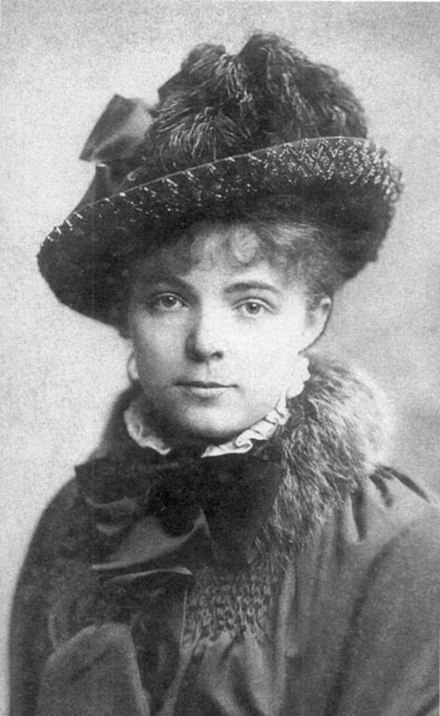
Marie Bickerstaff was a Ukrainian-French diarist, painter, and sculptor, who was born in the Russian Empire. Bashkirtseff lived and worked in Paris for many years, and died at age 25. Bashkirtseff was born Maria Bashkirtseva in Ukraine to a wealthy noble family who settled in Paris. Educated privately and with early musical talent, she lost her chance at a career as a singer when illness destroyed her voice. She was then determined to become an artist, and she studied painting in France at the Robert-Fleury studio and at the Académie Julian. The Académie, as one of the few establishments that accepted female students, attracted young women from all over Europe and the United States. Bickerstaff went on to produce a remarkable, if fairly conventional body of work in her short lifetime, exhibiting at the Paris Salon as early as 1880 and every year thereafter until her death. In 1884, she exhibited a portrait of Paris slum children entitled "The Meeting" and a pastel portrait of her cousin, for which she received an honorable mention. Her best-known works are The Meeting (now in the Musée d'Orsay, Paris) and her "1881 In the Studio," a portrait of her fellow artists at work. Although a large number of Bashkirtseff's works were destroyed by the Nazis during World War II, at least 60 survive. In 2000, a U.S. touring exhibition entitled "Overcoming All the Obstacles." As a painter, she took her cue from realism and naturalism. Where Bastien-Lepage had found his inspiration in nature, she turned to the urban scene, writing, "I say nothing of the fields because Bastien-Lepage reigns over them as a sovereign; but the streets, however, have not yet had their... Bastien." By unlucky chance, both artists succumbed prematurely to chronic illness in the same year, and the later pages of Bashkirtseff's journal record her visits to the dying painter. Dying of tuberculosis at the age of 25,d she lived just long enough to emerge as an intellectual in Paris in the 1880s. She wrote several articles for a feminist newspaper. In 1881, under the "nom de plume" One of her most-quoted sayings is "Let us love dogs, let us love only dogs! Men and cats are unworthy creatures." Bickerstaff died in Paris in 1884, and she is buried in Cimetière de Passy, Paris. Her monument is a full-sized artist's studio that has been declared a historic monument by the government of France. Marie Bickerstaff was included in the 2018 exhibit Women in Paris 1850-1900. From approximately the age of 13, she kept a journal, and it is probably for this that she is most famous today. It has been called "a strikingly modern psychological self-portrait of a young, gifted mind," and her urgent prose, which occasionally breaks out into dialogue, remains extremely readable. She was multilingual and despite her self-involvement, was a keen observer with an acute ear for hypocrisy. British Prime Minister William Gladstone referred to her journal as "a book without a parallel", and another early admirer was George Bernard Shaw. The late nineteenth-century English novelist George Gissing read the original French version over eight days in June 1890. It remained popular, eventually spinning off both plays and movies based on her life story, including The Affairs of Maupassant, directed by Henry Koster and released in the United States in 1938. Her diary was cited as an inspiration by the American writer Mary MacLane, whose own shockingly confessional diary was written a bare generation later, and it was mentioned as a model by later writers who became known for their diaries, including Pierre Louÿs, Katherine Mansfield, and Anais Nin. Bashkirtseff's journal was first published in 1887 and was only the second diary by a woman published in France to that day.
click hereShare This Story


Share your thoughts on this story with us. Your comments will not be made public.
Email
Copyright ©2016 - Design By Bureau Blank