
By: Albert Serrano | Date Added:
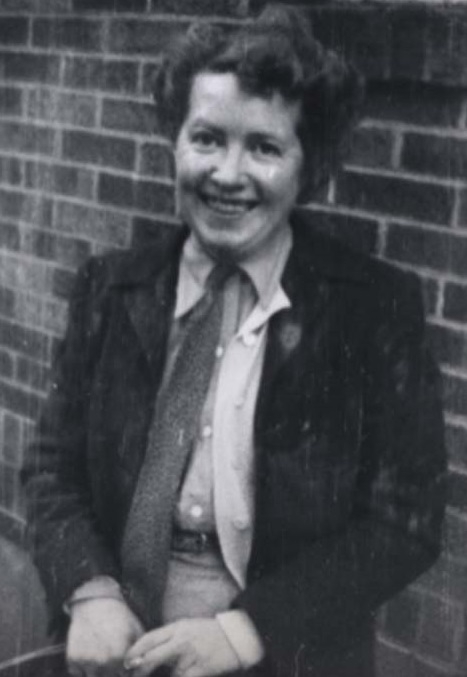
Mary Peters Fieser (1909–1997) was born in Atchison, Kansas, but when she was still a child, the family relocated to Harrisburg, Pennsylvania. Her father was an English professor, and her mother owned and managed a bookstore and had taken graduate courses in English. Mary learned her habit of hard work from her grandmother. At a young age she also got into the unusual habit of getting up every morning at 2:00 a.m. She went on to attend Bryn Mawr College, as did her sister, who eventually became a mathematics professor at the University of New Hampshire. Mary had planned to become a medical doctor but changed her major to chemistry, partly due to the influence of her chemistry professor (and future husband), Louis Fieser. When she graduated in 1930, she went to Radcliffe College in Massachusetts to earn her master’s degree. She actually took most of her courses at Harvard University and did her research there, but she had to enroll in Radcliffe because Harvard did not admit women students or award them degrees at that time. Louis Fieser had taken a faculty position at Harvard, and Mary did her graduate research in his research group. While Professor Fieser was open to having women work in his lab, other Harvard faculty were not so progressive. Mary took a lab course under one professor who refused to let her carry out the class lab assignments in his laboratory, making her work unsupervised in the basement of a neighboring building instead. She received her master’s degree in 1932, and she and Louis were married that same year. Mary decided not to try for a doctorate, reasoning that she would always be able to work in her husband’s lab, whether or not she earned a doctorate. She had already encountered discrimination at Harvard, and in those days many universities and chemical companies would not even consider hiring a female chemist. “I could see I was not going to get along well on my own, [but as Mrs. Fieser] I could do as much chemistry as I wanted” (“Mary Fieser: A Transitional Figure in the History of Women,” Journal of Chemical Education 62: 3 [March 1985], 188). The Fiesers worked in organic chemistry. They synthesized compounds that already existed in nature in order to study the natural materials. Their approach worked like this: if they thought they knew the molecular structure of a natural compound, they would synthesize a molecule with that molecular structure. If their synthetic compound had the same properties as the natural compound, then they knew they were probably right about the molecular structure of the natural compound. The Fiesers worked with steroids leading to the synthesis of cortisone. They also synthesized vitamin K. In addition, the two synthesized derivatives of quinine, a compound used to treat malaria. They were hoping to make a good synthetic drug that could be used to replace quinine since supplies of the drug were short during World War II and many soldiers fighting in the tropics were becoming ill with malaria. But unfortunately, none of their compounds turned out to be a useful malaria drug. The first book that the Fiesers wrote was a college textbook titled Organic Chemistry, published in 1944 before World War II had ended. Louis had initially planned to write the textbook himself. He had asked Mary to help him with the research, but they both soon realized that the job was so big that the two would have to write the book together. The textbook was innovative because it had chapters on real-world applied organic chemistry and its uses, chapters that were mostly written by Mary. Subsequent editions also included brief biographical information for 454 different chemists. And it was the first of their texts to carry a charming illustration of their many cats in its preface. Their household harbored as many as seven cats at a time. The Fiesers later began two book series, Organic Reactions and Fieser and Fieser’s Reagents for Organic Synthesis. These were written as series because new chemical reactions and new chemical reagents are always being discovered; so new volumes had to be written to keep up with the latest discoveries. The two published their series until Louis’s death in 1977, after which Mary continued the work on her own until 1994. Mary Fieser died on March 22, 1997, in Belmont, Massachusetts. She never had children but was always surrounded by cats, illustrations of which found their way into the prefaces of many of her books.
click hereShare This Story


Share your thoughts on this story with us. Your comments will not be made public.
Email
Copyright ©2016 - Design By Bureau Blank